
About the recordist — Akito Haga
The forest of small birds
I farm in the mountains of Gifu, in central Japan.
Watermelon, squash, peanuts, potatoes, nābēra (Okinawan luffa), green beans. Buntan pomelo, lemon, Mizuki (a new pomelo variety), dekopon, Kitaro (a persimmon), kiwi, figs. Right now I am setting up a farm where people can come and pick figs.
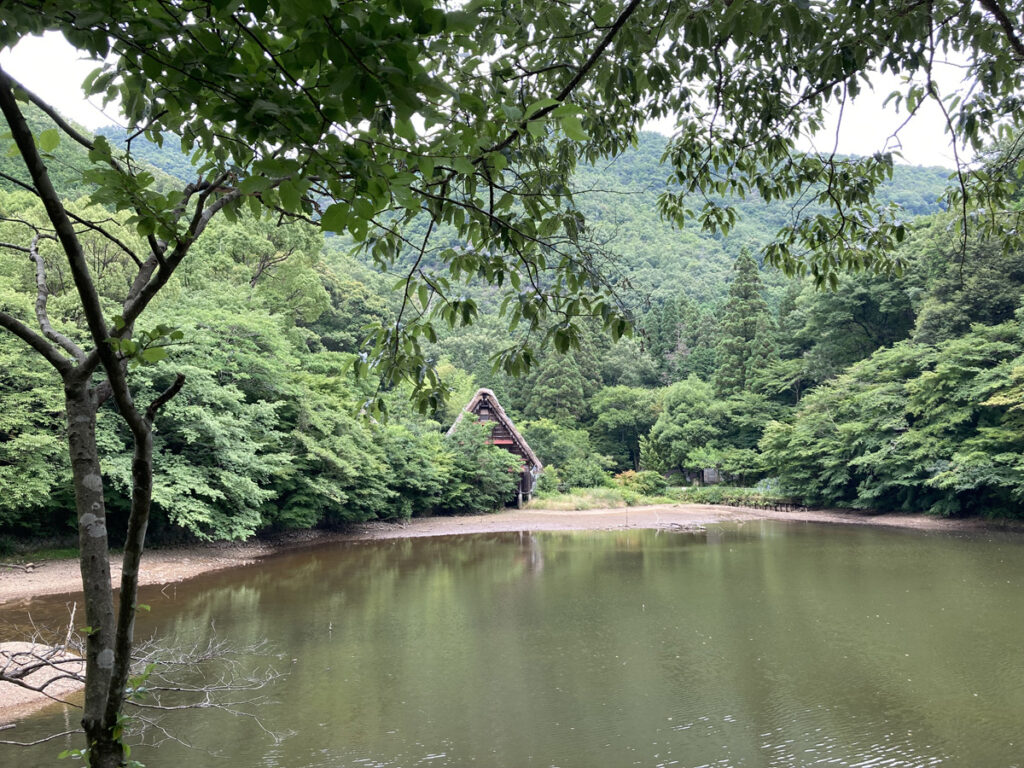
About ten years ago, I came across a forest full of birdsong. I began calling it the forest of small birds, and I went back again and again, to listen.
Their voices fill me up, just by being heard. In spring, the small birds sing. I have been told that singing is the voice of a bird looking for a mate, or spending a good hour with one. I do not know whether that is true. But listening with that in mind, I find myself wondering what they are saying just now, and it lifts me.
Listening to those beautiful voices, it even feels as though my body is being eased, and the clutter in my head swept out.
I wanted the real voices, at home
Birdsong contains high frequencies the human ear cannot hear. Learning that was what pulled me in deep.
I saw on television that this range has some mysterious power. When I looked into it, there did seem to be research reporting such things. But let me write this plainly: opinion among specialists is divided, and it cannot be said to be settled. Some attempts to reproduce the findings did not succeed. So I have no intention of claiming any effect.
Even so, I wanted to carry that forest home with me — its air and all, including the sounds I cannot hear.
A smartphone cannot record those high frequencies, so I got hold of equipment that can. Then I found that ordinary speakers cannot reproduce them, so I bought speakers that can. Burn it to a CD and the high frequencies are cut away. Make an MP3 and they are cut away too. I learned all of this one piece at a time.
I found a file format that keeps the high frequencies, and software that will play it, and played it through those speakers — and at last I could listen, at home, to something close to the real voices of the birds.
After that, I wanted to record much more.
The time spent waiting in the hills
I had a wooden box made for recording, with a recorder fitted inside. Animals come and interfere with the box from time to time, and on those nights the whole recording is rustling.
Gifu has a great many mountains. Takayama, Gujō, Sekigahara — and closer to home, Mitahora and Matsuo Pond. When I travel into the hills, the first thing I do is go up and set the recorder. I collect it the next day, or the day after, and go home. Hearing which birds turned up on it is the best part of the trip.
Some days I carry it in my hand instead. I wander the mountain looking for a voice worth having. When I find one I start recording and stand there, quite still, for ten minutes or more. If I move, my own footsteps go onto the recording, so I cannot move at all.
But standing still like that, listening to the birds, is the finest time I know. I lose track of it entirely. I keep walking and find I have reached the summit — where there are hardly any birds at all. Coming down a pitch-dark mountain path is a regular occurrence.
I have now recorded more than a hundred times.
Birds I love
My favourite is the Japanese grosbeak — ikaru.
“Pipii popyuuii,” it sings, sweetly. Its voice carries, but it is hard to find. Sometimes you are hearing it reflected off the mountain opposite; sometimes it is calling from a very long way off.
And one more: the blue rock thrush — isohiyodori.
“Piiruurii popiiri pipi, jijitt.” A truly beautiful way of singing. It was a coastal bird originally, and it has spread inland into towns, where it sings from rooftops and aerials — which is why it is so hard to record it anywhere quiet.
For a long time, I thought this bird was a blue-and-white flycatcher — oruri. I only realised my mistake when I went back and looked at my own photographs. The real blue-and-white flycatcher lives in forests along mountain streams. I have not recorded one yet.
Some birds are a little dull, too monotonous. But apart from the crow, I love every bird’s voice. (A crow is not a small bird, of course.)
Why an alarm clock
It began with a sleep researcher I saw talking on television.
There was a child who found mornings very hard — never got up, and was in a foul mood when he did. His mother, at her wits’ end, tried what the researcher described.
The next morning, at the time the alarm was set, the boy got up far earlier than usual and came through in a good mood, imitating a bird: “piiyo, piiyo.” His mother was astonished, and could not understand it.
That is exactly the mechanism of Songbird Alarm. Or rather, this app is that, copied straight across.
When sleep is deep, it is better not to wake someone. Being hauled out of it by a loud sound feels bad — and for a child, all the worse. So what was needed was a sound so quiet that it will not wake you out of deep sleep, but which you cannot miss once your sleep has turned light. And a sound that is not machinery, but something as beautiful as a bird.
I am not good at waking up myself. There are days when I have to be up before dawn for a delivery. So I made myself one track that started quiet and slowly grew, and set it as my phone’s alarm. It really does wake you pleasantly.
But it was the same track every morning. This bird starts, then this one sings like this — I learned all of it by heart. And then it stops working.
Happily, I have a great many recordings. Even within one species, the singing is entirely different from bird to bird — and even one bird sings in many ways. There must be meaning in what they are saying, I imagine.
I want those many changing voices to wake you, in a different order every morning.
That was my ambition for years. The farm work always came first and I never got to it, but at last it is done.
What comes next
The free version plays three forest sounds at random. Listen every morning and, after a few months, you may tire of them.
When that happens, treat yourself to the paid version. Countless beautiful voices, a different face every morning.
From the mountains of Gifu — Akito Haga