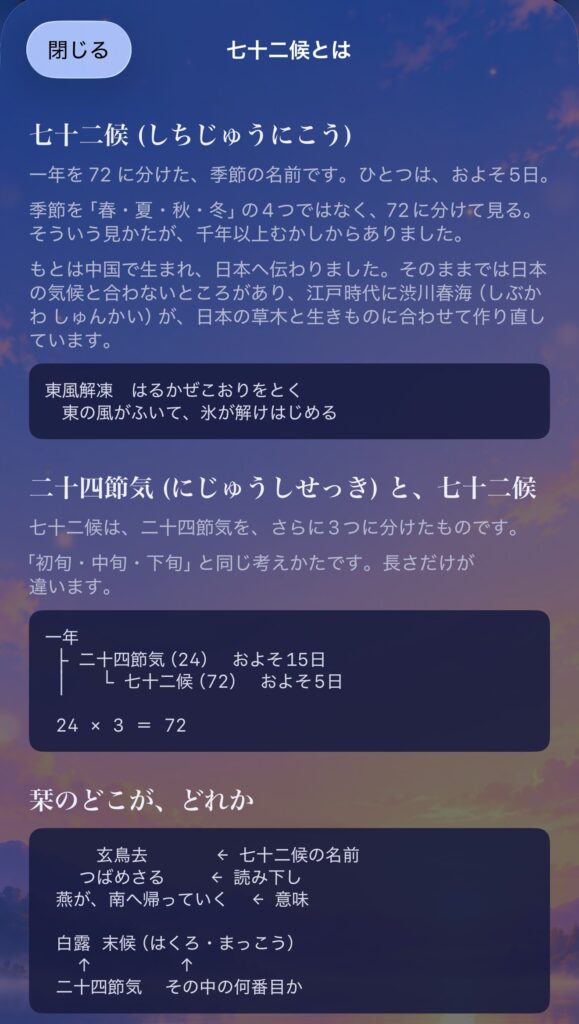
In the old Japanese calendar, the year is divided into 72 small seasons, each with its own name. They are called the 72 seasons (七十二候, shichijūni-kō). Each lasts about five days.
On a night you tap “Good night”, the bookmark for that day’s season becomes yours. Over a year, 72 of them. These are the Season Bookmarks.
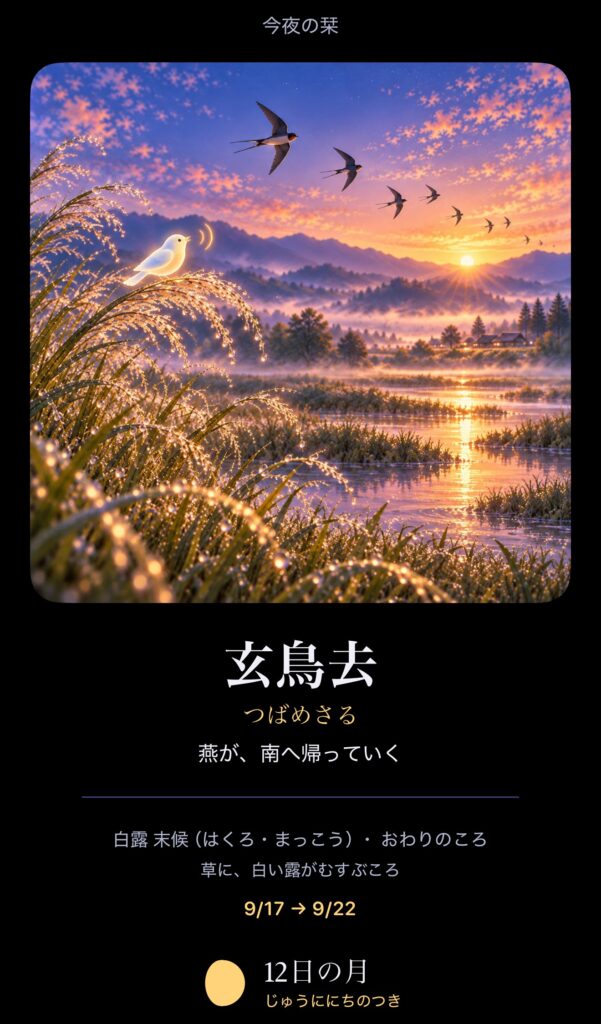
Tonight’s Bookmark
When you tap “Good night”, the sleep sound starts, and tonight’s bookmark appears over it.
- Touch anywhere on the screen once and it goes away. If you don’t touch it, it goes away by itself after 30 seconds.
- While the bookmark is showing, the alarm is already set. Even if you fall asleep looking at it, the morning goes as usual.
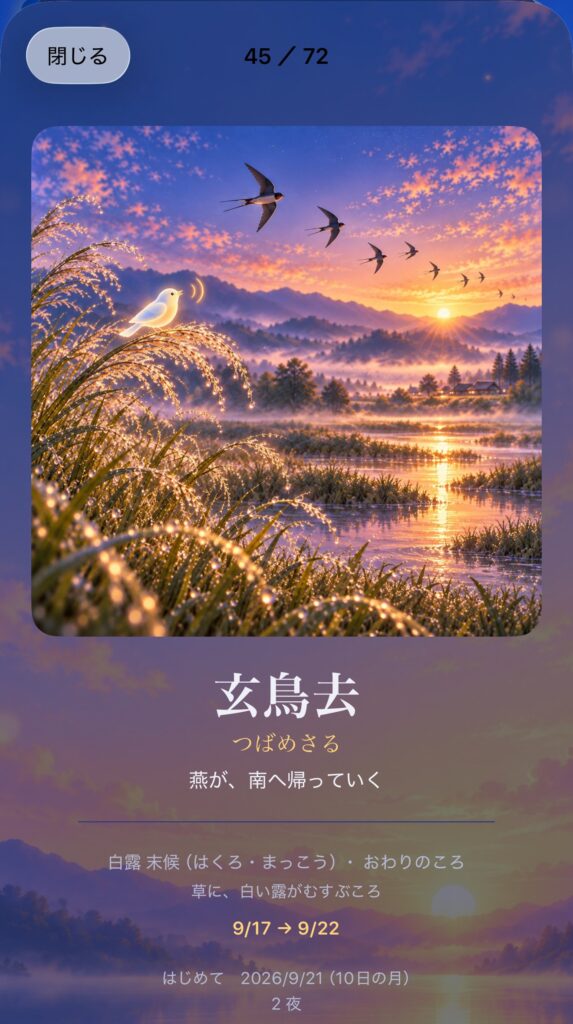
A bookmark shows:
| Picture | A picture of that season |
| Season name | In the original kanji, e.g. 玄鳥去 |
| Reading | How the name is read, e.g. Tsubame saru |
| Meaning | What that season is like, e.g. “Swallows head back to the south.” |
| Solar term | Which of the 24 solar terms it belongs to, and which part, e.g. 白露 末候 (Hakuro · Makkō — the last part), and the dates of the season, e.g. Sep 17 → Sep 22 |
| Moon | That night’s moon and its name, e.g. 12日の月 (Jūninichi no tsuki) |
Only the kanji names are kept as they are, even in other languages. They are names, and names are not translated. The meaning is given on its own line.
How bookmarks are collected
- On a night you tap “Good night”, you get that day’s season.
- Whether you slept well does not matter. Any night you tap it, you get it.
- Each season lasts about five days. Tap once on any of those days and the season is yours. Miss all of them, and it comes round again next year.
- Tapping several times in the same season still gives one bookmark. The number of nights is kept under the bookmark, as “2 nights” and so on.
Season Bookmarks (all 72)
You can open the Season Bookmarks from two places:
- The line just under the title on the home screen (today’s season name and reading)
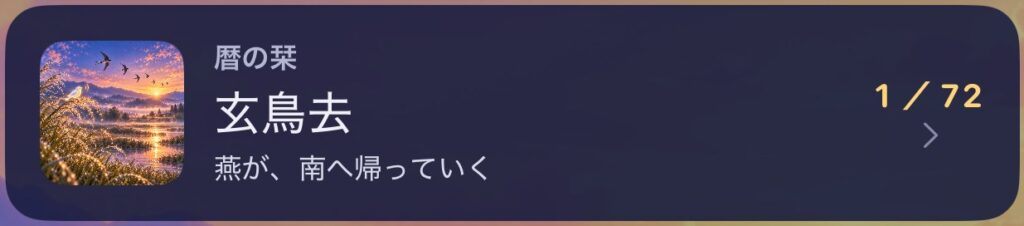
- The “Season Bookmarks” card in the Wake log (a picture of today’s season, and how many you have collected)
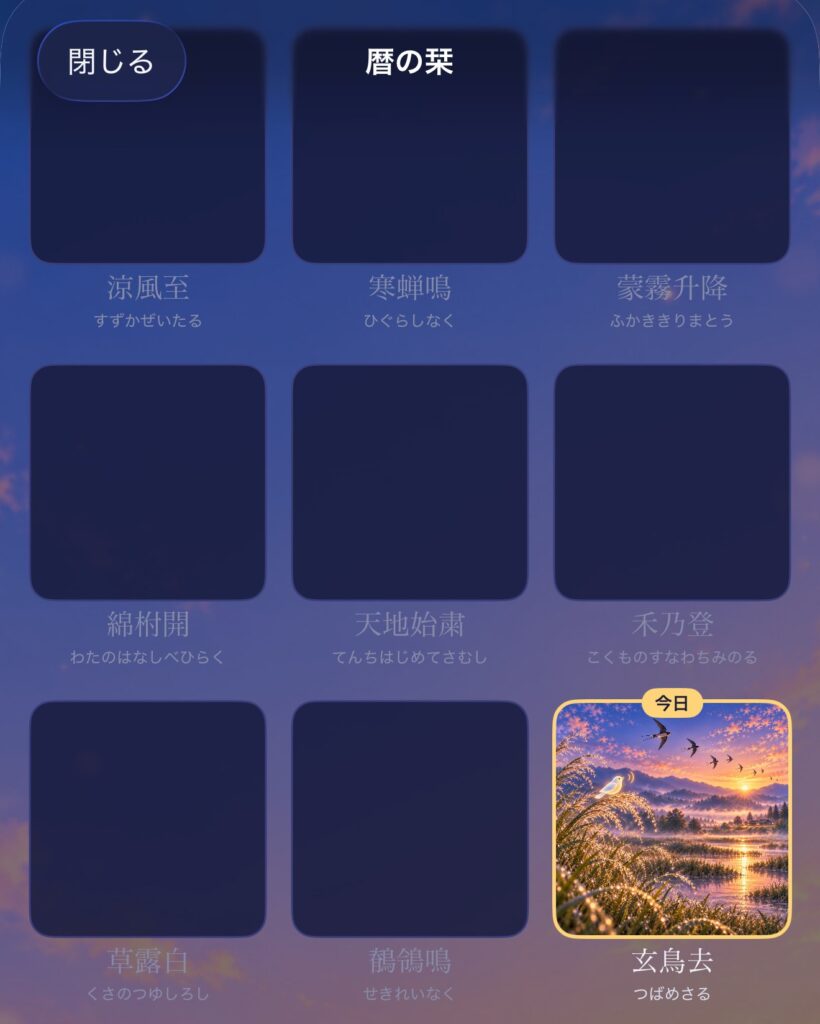
- When it opens, today’s season is in the middle. You never have to search through 72 bookmarks.
- Even seasons you have not collected yet show their names and readings. Only the picture is empty. You can use it as a calendar any time; the picture is the reward for the night you tapped.
- Tap a bookmark to open it large, and swipe left and right to turn the pages. However far you go, “Today” at the top right brings you straight back.
The moon is not a picture
The moon at the bottom of a bookmark is not a drawing made in advance. Its shape is calculated from the moon of that night. If the right side is lit, the moon is waxing; if the left side is lit, it is waning.
In Japanese, many nights of the moon have their own names. Izayoi (十六夜, the “hesitating” moon), Tachimachizuki (立待月), Imachizuki (居待月), Nemachizuki (寝待月). After the full moon, the moon rises later each night, and these names follow the wait: the moon you wait for standing, then sitting, then lying down.
Even for the same season, this year’s moon is not last year’s moon.
The dates change every year
The dates of the 72 seasons are set by the position of the sun, not by the calendar. So the same season can start a day earlier or later in a different year.
The app has no table of dates. It calculates the start of each of the 24 solar terms from the position of the sun, and divides each one into about five-day parts. It is the same calculation the app uses for sunrise and sunset.
There are no official dates for the 72 seasons today. They were taken out of the Japanese calendar in the early Meiji era, and have stayed that way. Different almanacs and websites may differ by a day.
Names, pictures and words
The 72 seasons were born in China and were rewritten in the Edo period to fit the seasons of Japan. Even so, some of the kanji in the names do not match the plants and animals of Japan today.
In this app, not a single kanji of the season names has been changed. The meaning line, however, follows what is drawn in the bookmark’s picture, because the pictures came first and the words were written afterwards.
| Season | Reading | What the picture shows | What the bookmark says |
|---|---|---|---|
| 金盞香 | Kinsenka saku | A flower with white petals and a yellow cup | Narcissus |
| 山茶始開 | Tsubaki hajimete hiraku | A flower whose petals fall one by one (a camellia drops the whole flower) | Sasanqua camellia |
| 鱖魚群 | Sake no uo muragaru | A fish with a red side, leaping up a river | Salmon |
| 蟋蟀在戸 | Kirigirisu to ni ari | An insect with long antennae | Katydid |
| 楓蔦黄 | Momiji tsuta kibamu | Maples in autumn colour (no ivy in the picture) | The maples turn yellow and red |
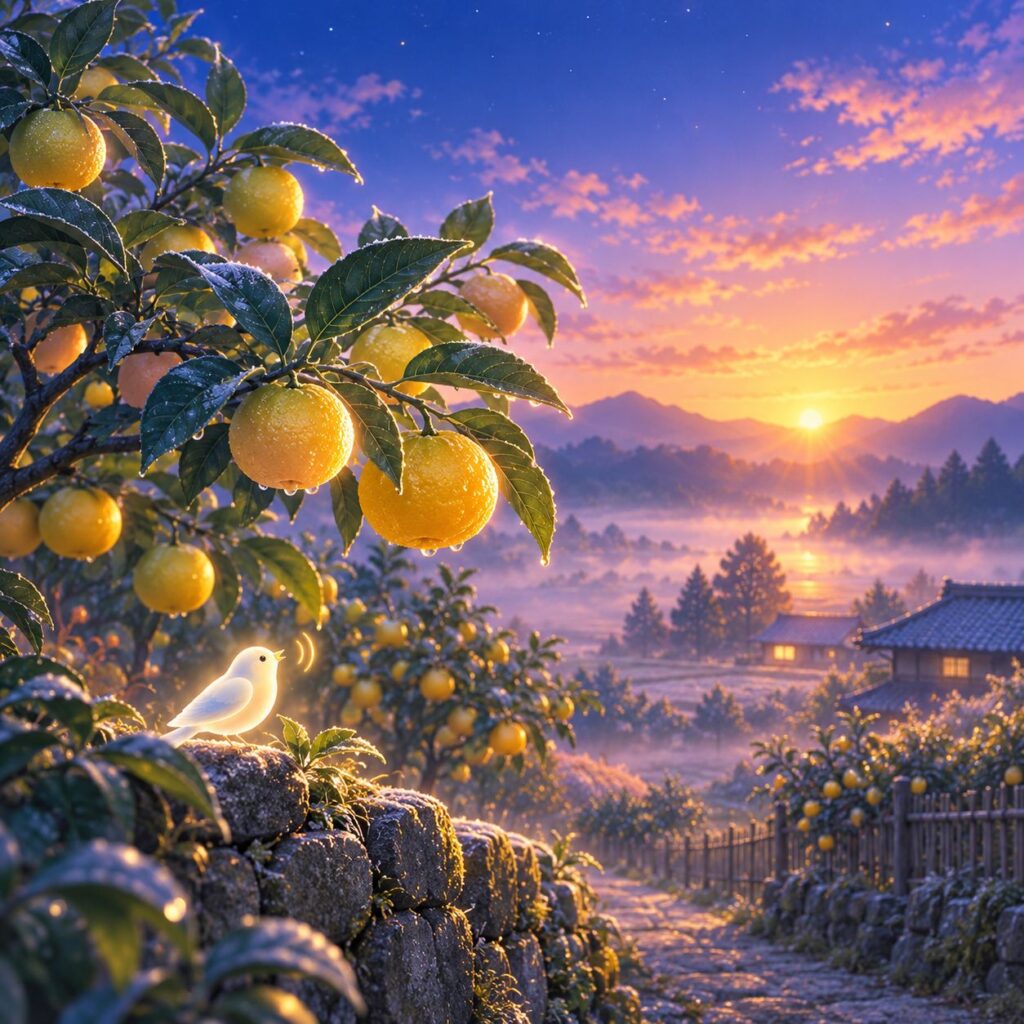
| 橘始黄 | Tachibana hajimete kibamu | Large yellow fruit (a tachibana fruit is only about 3 cm) | The citrus fruits turn yellow |
Note: some say that 蟋蟀 originally meant a cricket. This app chose the insect that fits both the reading (kirigirisu) and the picture.



What is it for?
The 72 seasons began as a guide for farm work. When there were no clocks or calendars at hand, the sky and the plants told people when to sow and when to prepare for winter.

Today, they don’t need to be useful. But when the name of the season changes every five days or so, the same days start to look a little different. If it makes you step outside and look up at the sky, that is enough.
You can read more under “About the 72 seasons” at the bottom of the Season Bookmarks.