Songbird Alarm — about the sounds
Every sound in this app was recorded by the developer himself, in the mountains of Gifu, Japan.
Waiting in the hills
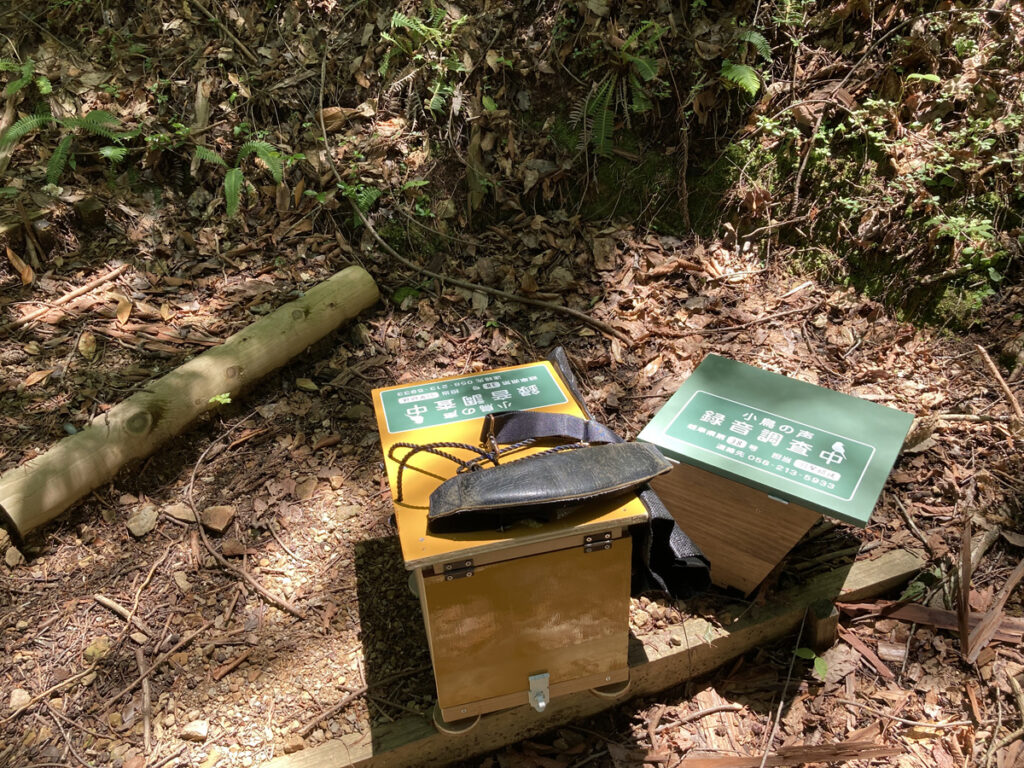
I had a wooden box made for recording. A recorder goes inside it, and I leave it out in the hills. Animals come and interfere with the box from time to time, and on those nights the whole recording is rustling.
Some days I carry it in my hand instead. I wander the mountain looking for a voice worth having, and when I find one I start recording and stand there, quite still, for ten minutes or more. If I move, my own footsteps go onto the recording, so I cannot move at all.
I have now recorded more than a hundred times.
As far as the sounds we cannot hear
Birdsong contains high frequencies that the human ear cannot hear.
A smartphone cannot record those. So I use equipment that reaches them. Burn it to a CD and the high frequencies are cut away. Make an MP3 and they are cut away too. I learned all of this one piece at a time.
There is talk of that frequency range having some mysterious power. Opinion among specialists is divided, and it cannot be said to be settled — some attempts to reproduce the findings did not succeed. So I have no intention of claiming any effect.
Even so, I wanted to carry that forest home with me — its air and all, including the sounds I cannot hear.
Not touching the sound
I try to do as little as possible to what I have recorded.
- No compression. No limiter. The distance between the quiet sounds and the loud ones stays as it was
- No noise removal. Remove the noise, and the air of the forest goes with it
- When levels need matching, I lift the whole thing by the same amount. Nothing more
You will sometimes hear wind, or a car far away. Those sounds were really there, on that day, in that place.
What is in the app
Night sounds (they play very quietly, all night)
- A forest at midnight
- A night of rain
- A night of bell crickets
Morning sounds (they grow over 15 minutes from your wake-up time)
- Forest at midday, forest at dusk, forest in the rain
The finish
- A Japanese bush warbler
Morning music (you can keep it playing after you stop the alarm)
Birds I love
My favourite is the Japanese grosbeak — ikaru.
“Pipii popyuuii,” it sings, sweetly. Its voice carries, but it is hard to find. Sometimes you are hearing it reflected off the mountain opposite; sometimes it is calling from a very long way off.
And one more: the blue rock thrush — isohiyodori.
“Piiruurii popiiri pipi, jijitt.” A truly beautiful way of singing. It was a coastal bird originally, and it has spread inland into towns, where it sings from rooftops and aerials — which is why it is so hard to record it anywhere quiet.
For a long time, I thought this bird was a blue-and-white flycatcher — oruri. I only realised my mistake when I went back and looked at my own photographs. The real blue-and-white flycatcher lives in forests along mountain streams. I have not recorded one yet.
The picture is still; the sound is what matters. (Sound on.)
About using these recordings
All the birdsong in the app was recorded by the developer, Akito Haga. The copyright belongs to the recordist. Please do not use the recordings in any way other than playing them inside the app — no recording, copying, distribution, or use in video or in shops.
For enquiries, please write to otoiawase@kotorinokoe.com
What comes next
There are many more voices in my collection. Even within one species, the singing is entirely different from bird to bird — and even one bird sings in many ways.
I want those many changing voices to wake you, in a different order every morning.
That is why I made this app. The paid version will bring them to you, a little at a time.