The way Songbird Alarm analyses your records is not made up. It follows methods proposed in sleep medicine and chronobiology.
But an iPhone can only know so much. It cannot see brain waves, body temperature, or whether you were really asleep. So for each method, this page sets out the original definition and how this app calculates it, and where the two differ.
The app screens on this page were taken with sample records made automatically for this explanation. They are not a real person’s records.
We only use a name when a method has one, and we do not invent official-sounding names for things that have none. The papers listed here are the ideas behind the app’s calculations. They do not mean that any paper has endorsed this app.
1. From a very quiet sound, little by little — how the app wakes you
How deeply you sleep changes what you hear
Since the 1960s, sleep research has shown again and again that the quietest sound that can wake you (the auditory arousal threshold) differs greatly between sleep stages.
In deep sleep (slow-wave sleep), the brain responds only to fairly loud sounds. In light sleep and REM sleep, even quiet sounds are noticed. Through the night, sleep keeps getting deeper and lighter again.
At your wake time, the app starts the forest birdsong at a level you can hardly hear, and raises it slowly over about 15 minutes. The idea is to wait for a moment of light sleep, when a quiet sound is enough to wake you. At the end, a clear call of the Japanese bush warbler (uguisu) sounds.
- Williams HL, Hammack JT, Daly RL, Dement WC, Lubin A (1964) Responses to auditory stimulation, sleep loss and the EEG stages of sleep. Electroencephalography and Clinical Neurophysiology 16:269–279.
- Rechtschaffen A, Hauri P, Zeitlin M (1966) Auditory awakening thresholds in REM and NREM sleep stages. Perceptual and Motor Skills 22:927–942.
- Rosa RR, Bonnet MH (1985) Sleep stages, auditory arousal threshold, and body temperature as predictors of behavior upon awakening. International Journal of Neuroscience 27(1–2):73–83. doi:10.3109/00207458509149136
The kind of sound matters too
A study published in 2020 (RMIT University, Australia) reported that people who woke to a melodic sound reported less grogginess just after waking (sleep inertia) than people who woke to a monotonous “beep-beep”. This is one of the reasons we chose birdsong.
- McFarlane SJ, Garcia JE, Verhagen DS, Dyer AG (2020) Alarm tones, music and their elements: Analysis of reported waking sounds to counteract sleep inertia. PLOS ONE 15(1):e0215788.
Note: these are studies of sleep and sound. None of them tested this app’s way of waking you.
2. Analysing your records — the original definition and this app’s calculation
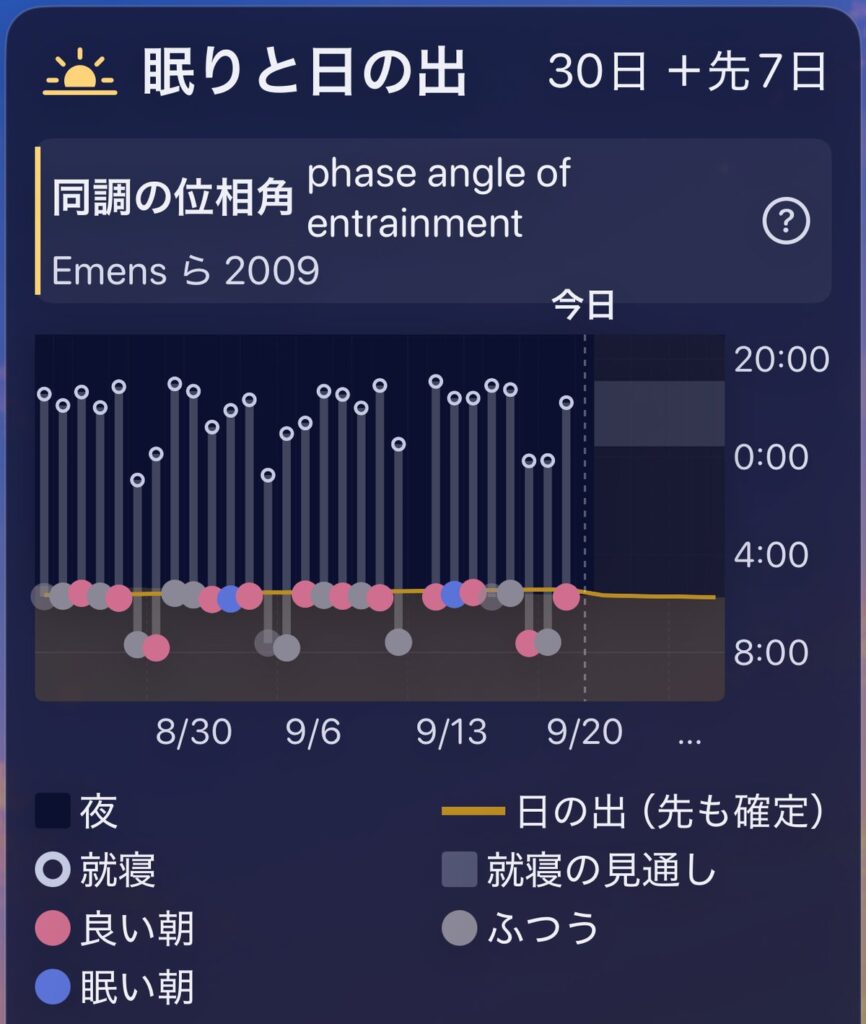
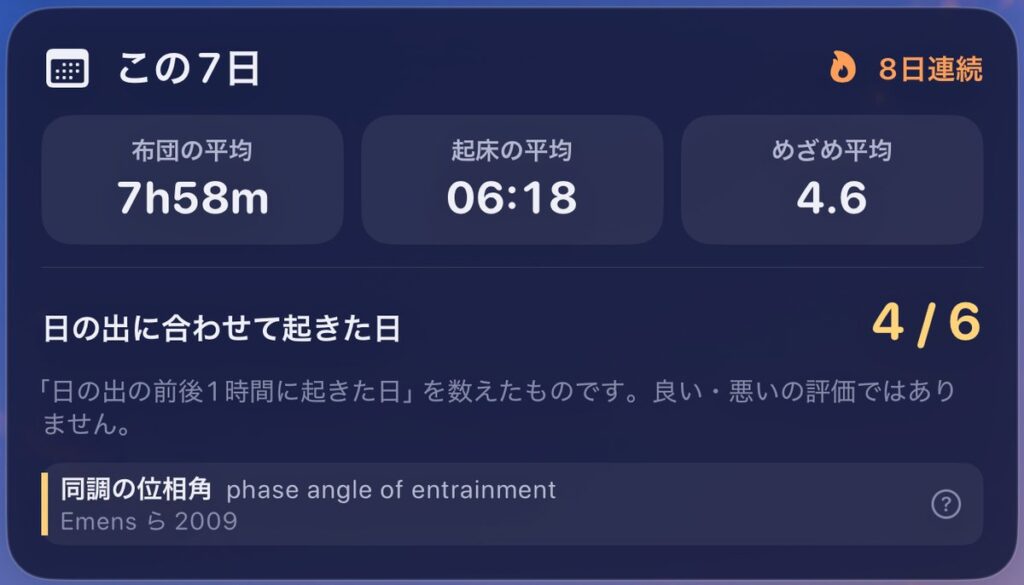
Phase angle of entrainment
- In the app: Wake log “Days you woke with the sun”, and the Bird’s Observatory “Sleep and sunrise”
- Original definition: The interval between a point in the body clock and the time you are exposed to light.
- How this app calculates it: The body clock cannot be measured, so the app uses “wake time minus sunrise” instead. It is a guide, not the body clock itself.
- Emens JS, Yuhas K, Rough J, Kochar N, Peters D, Lewy AJ (2009) Phase angle of entrainment in morning- and evening-types under naturalistic conditions. Chronobiology International 26(3):474–493. doi:10.1080/07420520902821077
Mid-sleep and chronotype
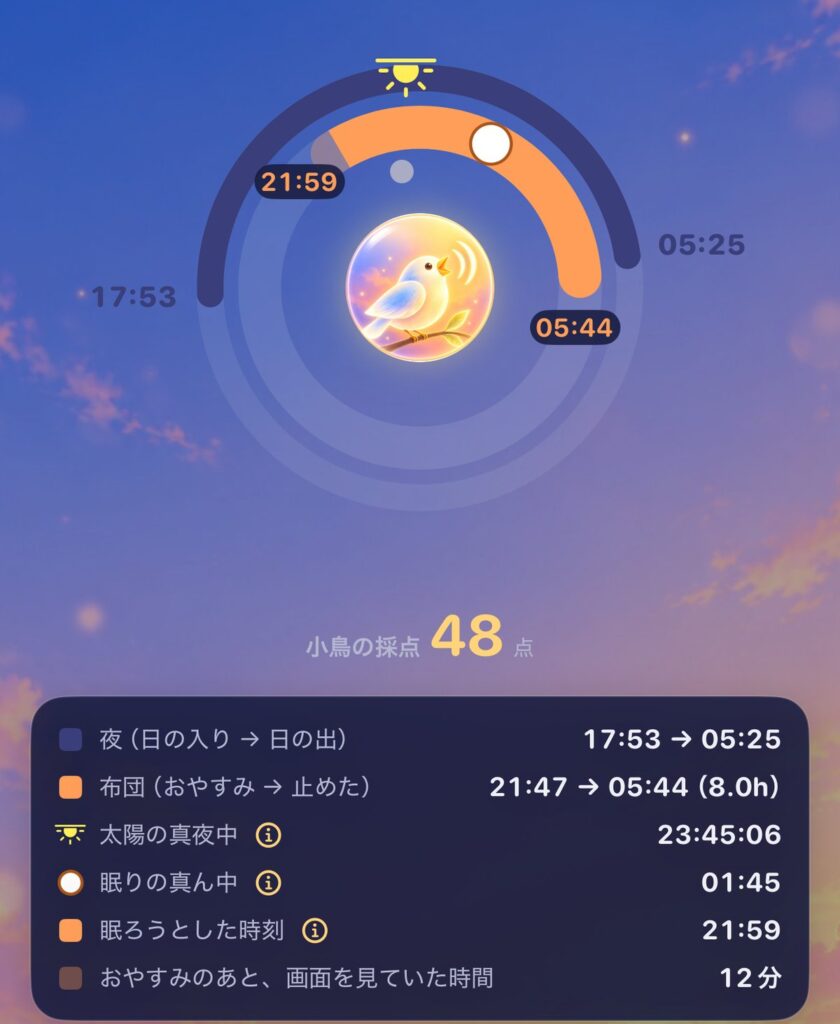
- In the app: “Mid-sleep” on The shape of last night (the ring)
- Original definition: The exact midpoint between falling asleep and waking. A guide to where a person’s body clock sits.
- How this app calculates it: The midpoint between “Good night” and “Stop”. It includes the time it took you to fall asleep, so it comes out a little earlier than the true mid-sleep.
- Roenneberg T, Wirz-Justice A, Merrow M (2003) Life between clocks: daily temporal patterns of human chronotypes. Journal of Biological Rhythms 18(1):80–90. doi:10.1177/0748730402239679
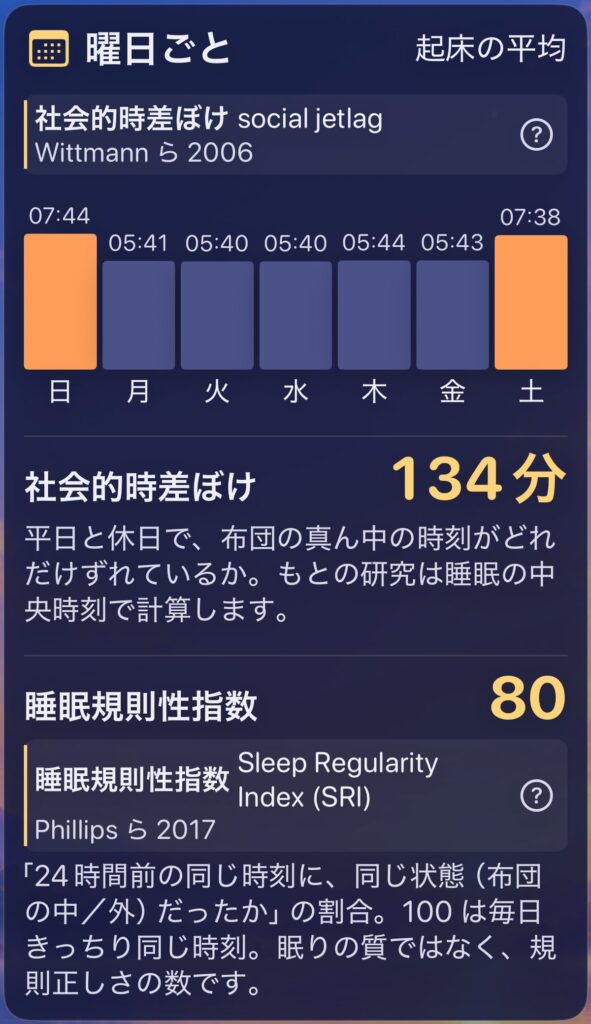
Social jetlag
- In the app: The Bird’s Observatory, “By day of the week”
- Original definition: How far the midpoint of sleep shifts between days off and work days.
- How this app calculates it: The app uses the midpoint of time in bed, because it cannot know when you fell asleep. Instead of weekdays and weekends, it compares “mornings when the alarm rang on an alarm day” with “other mornings”.
- Wittmann M, Dinich J, Merrow M, Roenneberg T (2006) Social jetlag: misalignment of biological and social time. Chronobiology International 23(1–2):497–509. doi:10.1080/07420520500545979
Sleep Regularity Index (SRI)
- In the app: The Bird’s Observatory, “By day of the week”
- Original definition: The probability of being in the same state (asleep or awake) at two time points 24 hours apart. From 0 to 100; 100 means exactly the same times every day.
- How this app calculates it: Instead of a dedicated movement sensor (actigraph), the app uses the time you were in bed. Time awake in the middle of the night is not counted, so the value comes out higher than it should. It measures regularity, not how well you slept.
- Phillips AJK, Clerx WM, O’Brien CS, Sano A, Barger LK, Picard RW, Lockley SW, Klerman EB, Czeisler CA (2017) Irregular sleep/wake patterns are associated with poorer academic performance and delayed circadian and sleep/wake timing. Scientific Reports 7:3216. doi:10.1038/s41598-017-03171-4
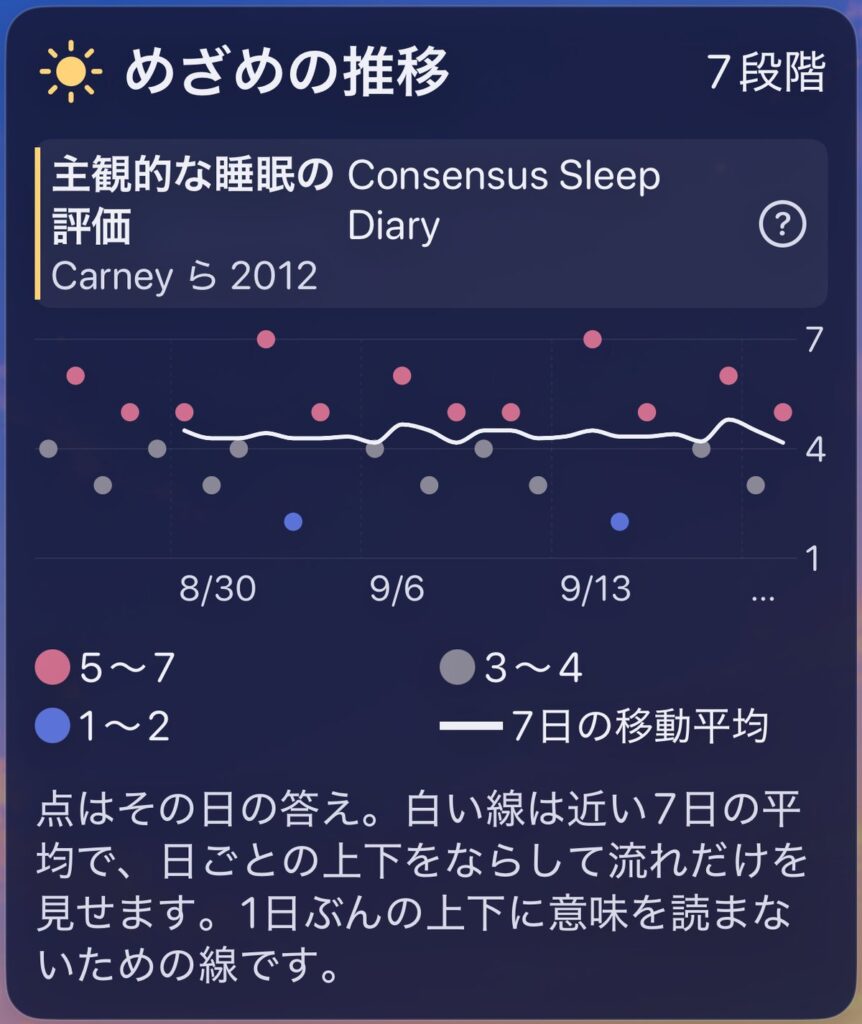
Rating your own sleep (Consensus Sleep Diary)
- In the app: The seven wake-up buttons each morning, and the Bird’s Observatory “How your mornings have gone”
- Original definition: First thing in the morning, you rate the night’s sleep yourself and write it down. An international sleep diary whose format was agreed by experts.
- How this app calculates it: The app uses seven buttons. The number of levels and their words are our own, made to be easy to choose from; they are not taken from the diary. Only the form — “answer right then in the morning; you cannot add it later” — follows this idea.
- Carney CE, Buysse DJ, Ancoli-Israel S, Edinger JD, Krystal AD, Lichstein KL, Morin CM (2012) The Consensus Sleep Diary: standardizing prospective sleep self-monitoring. Sleep 35(2):287–302. doi:10.5665/sleep.1642
Time you tried to sleep (lights out)
- In the app: The shape of last night (the ring), and the Wake log
- Original definition: A sleep diary asks “What time did you get into bed?” and “What time did you try to go to sleep?” as separate questions, so that time spent reading or looking at a phone in bed is not mixed up with sleep.
- How this app calculates it: The app estimates it without asking you. If the phone locks after “Good night” and stays locked for 15 minutes, the moment it locked is taken as this time. iOS does not tell apps when the screen turns on, so the lock signal is all the app can use. On an iPhone with no passcode, the signal never comes, so this time is not recorded.
- Carney CE et al. (2012) (the same paper as above)
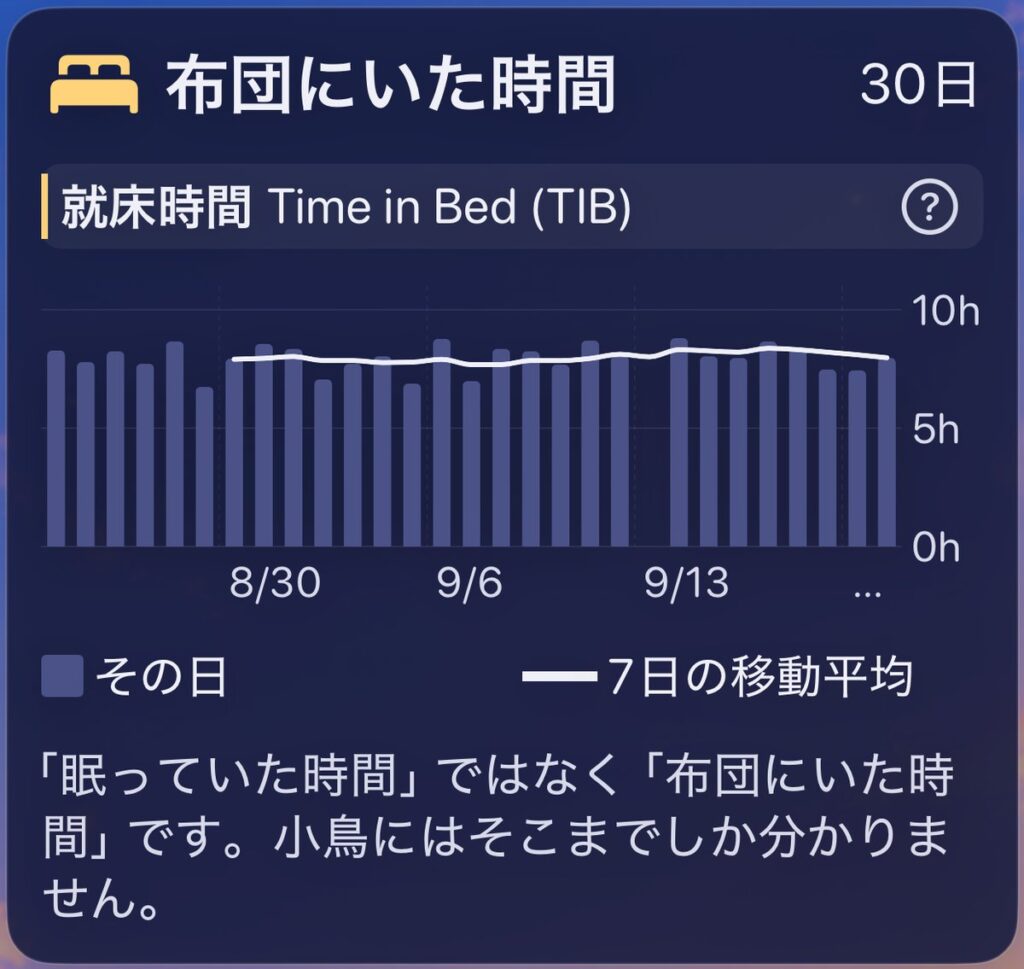
Time in bed (TIB)
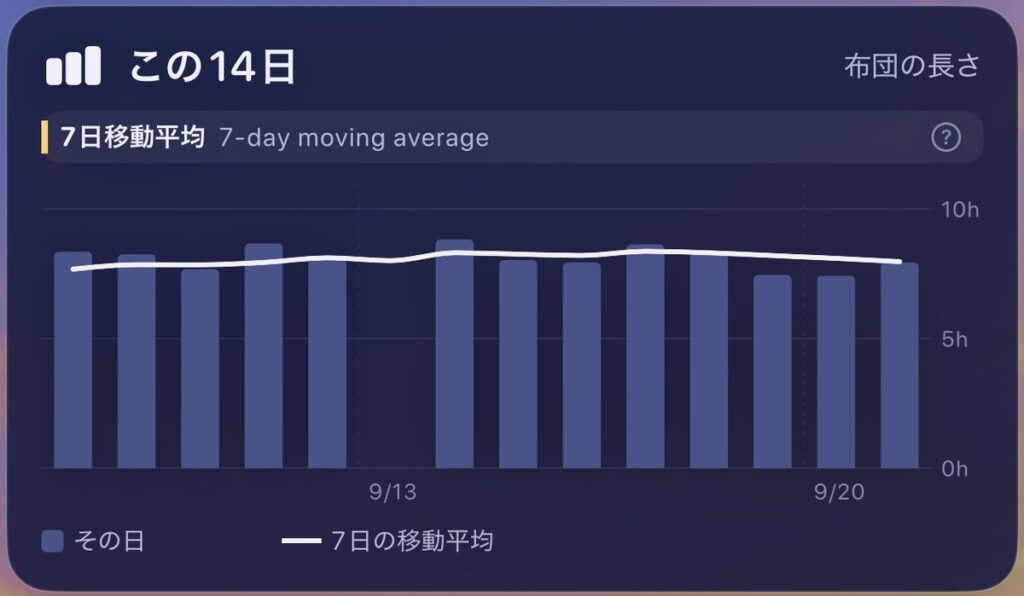
- In the app: The Bird’s Observatory “Time in bed”, and the Wake log “These 14 days”
- Original definition: Time in bed (TIB) and total sleep time (TST) are different things.
- How this app calculates it: The app only knows TIB (the time you were in bed). It cannot know TST (the time you were actually asleep). That is why the screens say “Time in bed”, not “sleep time”.
- Time in Bed (TIB) / Total Sleep Time (TST) — terms in general use in sleep medicine
3. The calculation tools
Statistical tools
- 7-day moving average: the average of the most recent 7 days, including that day. For the first 6 days, when there is not enough data, no line is drawn.
- Spearman’s rank correlation (ρ): used to learn the weights of the “Bird’s score” from your answers.
- Median absolute deviation (MAD): a measure of spread that is not pulled around by one unusual day.
These are all basic statistical tools, not the method of any particular paper.
What we can see — the rules before saying anything
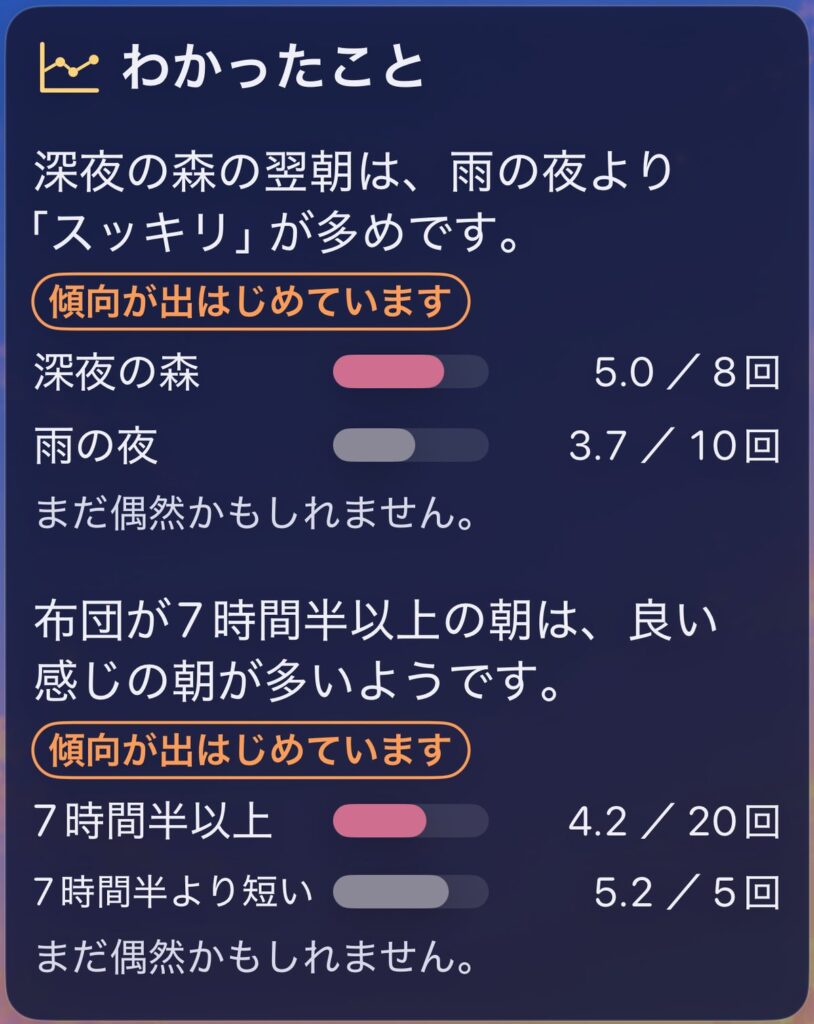
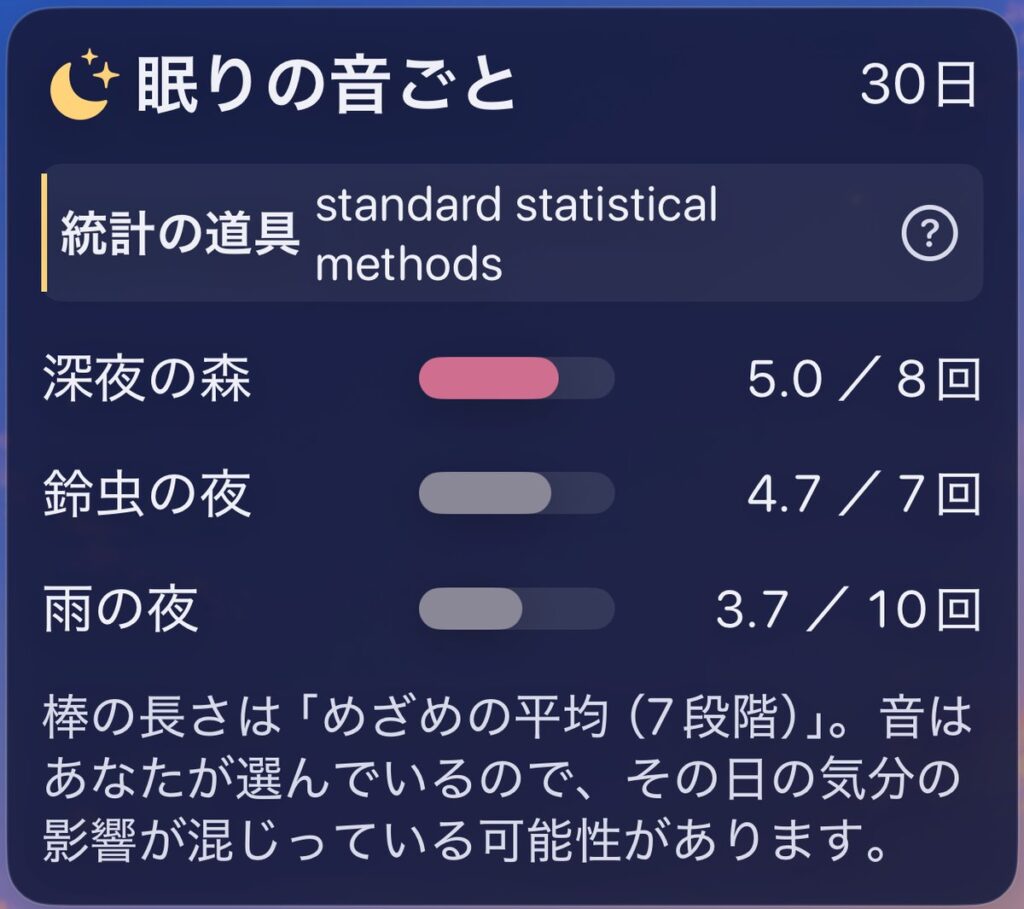
Do your morning answers differ with the kind of sleep sound, or with how long you were in bed? The app compares them, but it does not jump to conclusions.
- A pattern is starting: when both groups being compared have at least 5 mornings. The app adds “This could still be chance.”
- A clear pattern: only when both groups have at least 15 mornings, the difference is at least twice the spread, and it is at least 0.6 on the seven-level scale.
Sunrise and sunset
- Calculated on the iPhone alone from the latitude and longitude of where you are, without any network connection. Shown to the second.
- NOAA Solar Calculator / Jean Meeus, Astronomical Algorithms
4. What this app made itself
Bird’s score
This is not a proposed method. We made it. That is exactly why the app shows every part of the calculation on its “How the score works” screen.
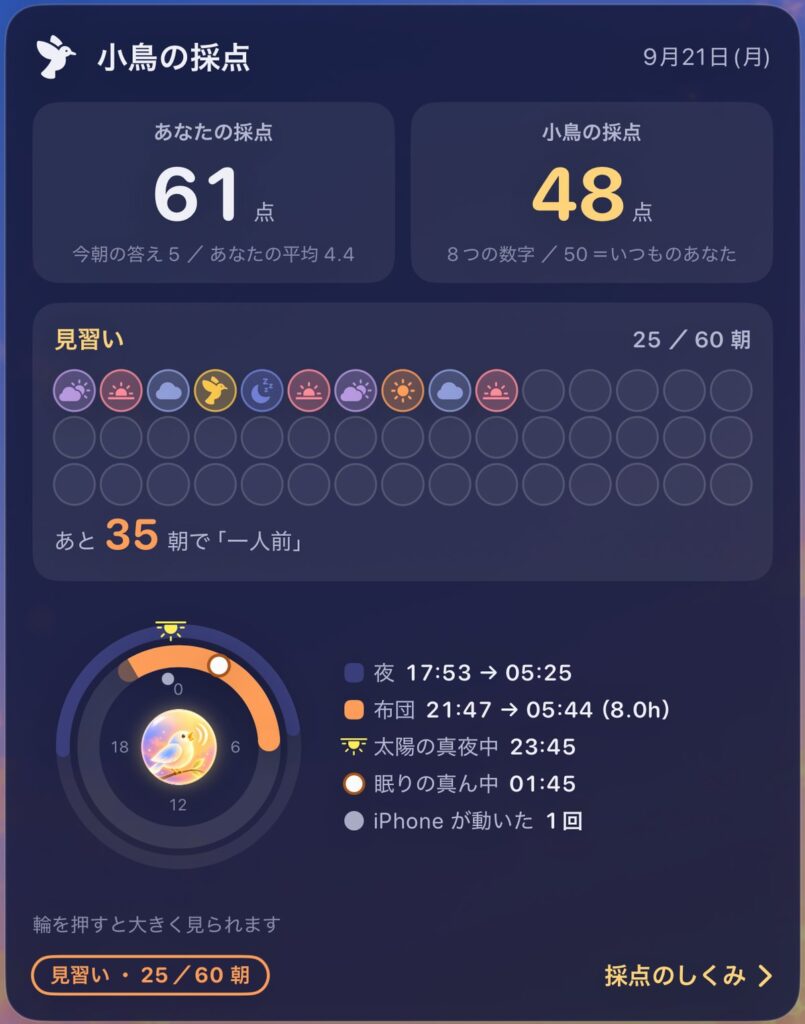
50 points means “your usual self”: the score is measured against you. It is not for comparing with other people, and it is not a medical assessment.
Until the bird learns your mornings
Knowing “your usual self” takes a number of mornings. As the mornings you have answered add up, the bird’s title changes.
| Mornings answered | Title | |
|---|---|---|
| 0–14 | In training | No score yet |
| 15–59 | Apprentice | Scores begin |
| 60–99 | Fully trained | The baseline of “your usual self” is complete at 60 mornings |
| 100–179 | Adept | |
| 180–259 | Doctor | |
| 260–364 | Professor | |
| 365+ | Legendary bird | A full round of the seasons |
The title depends only on the number of mornings answered. It never goes down unless you delete morning records yourself.
Please note
This app is not a medical device. If anything about your sleep worries you, please talk to a doctor.